Introduction
Heart failure (HF) represents a complex clinical syndrome affecting millions globally, characterized by the heart's inability to pump sufficient blood to meet metabolic demands. The management of HF has evolved significantly with the introduction of novel therapeutic agents and biomarker-guided strategies.
N-terminal pro-B-type natriuretic peptide (NT-proBNP) has emerged as a gold standard biomarker for HF diagnosis, prognosis, and therapeutic monitoring [1]. Elevated NT-proBNP levels correlate strongly with disease severity, hospitalization risk, and mortality in HF patients [2]. Studies have demonstrated that NT-proBNP levels >1000 pg/mL indicate poor prognosis, while values >5000 pg/mL suggest critical illness requiring intensive intervention [3]. The biomarker's role extends beyond diagnosis, as serial measurements help assess treatment response and guide therapeutic decisions [4].
Research by Januzzi et al. demonstrated that NT-proBNP-guided therapy reduced cardiovascular events and improved clinical outcomes compared to symptom-based management alone [5]. The TIME-CHF trial further validated biomarker-guided treatment strategies, showing potential benefits particularly in younger HF populations [6]. However, interpretation requires consideration of confounding factors including age, renal function, obesity, and atrial fibrillation, which can influence baseline values [7].
Traditional HF pharmacotherapy has centered on neurohormonal antagonism through angiotensin-converting enzyme inhibitors (ACEIs), beta-blockers, and mineralocorticoid receptor antagonists (MRAs) [8]. These foundational therapies have consistently demonstrated mortality reduction and symptom improvement in HF with reduced ejection fraction (HFrEF) [9]. Diuretics, while not improving survival, remain essential for congestion management and symptom relief [10].
Studies indicate that despite guideline recommendations, substantial therapeutic gaps persist, with many patients receiving suboptimal doses or incomplete combinations of guideline-directed medical therapy (GDMT) [11]. Medication adherence and physician inertia represent significant barriers to optimal HF management in real-world settings [12].
The therapeutic landscape has been revolutionized by angiotensin receptor-neprilysin inhibitors (ARNIs), with sacubitril/valsartan demonstrating superior outcomes compared to ACEIs in the PARADIGM-HF trial [13]. Sodium-glucose cotransporter-2 (SGLT2) inhibitors, initially developed for diabetes, have shown remarkable benefits across the HF spectrum, reducing hospitalizations and mortality regardless of diabetic status [14]. The DAPA-HF and EMPEROR-Reduced trials established dapagliflozin and empagliflozin as foundational HF therapies [15].
Recent additions include Vericiguat, a soluble guanylate cyclase stimulator, and Omecamtiv mecarbil, a cardiac myosin activator, offering additional options for persistently symptomatic patients [16]. These agents represent paradigm shifts toward comprehensive quadruple therapy approaches in contemporary HF management [17].
Real-world studies reveal heterogeneous prescribing patterns, with regional variations in GDMT adoption [18]. Tertiary care centers generally demonstrate higher utilization rates of novel therapies, though economic barriers and formulary restrictions limit accessibility in many healthcare settings [19]. Analysis of drug utilization patterns helps identify prescription gaps and opportunities for quality improvement interventions [20].
Aim & Objectives
To analyse progonostic marker NT-proBNP level in heart failure patients
To analyse the usage of conventional and new drug therapy utilization in heart failure patients
To assess the NT-proBNP guided drug therapy in heart failure patients
Materials & Methods
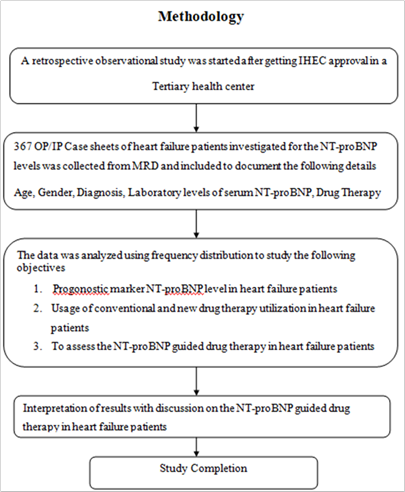
A cross-sectional study was started after getting IHEC approval (22/281) in a Tertiary health center. 367 OP/IP Case sheets of heart failure patients investigated for the NT-proBNP levels was collected from MRD and included in the study to document the following details like Age, Gender, Diagnosis, and Laboratory levels of serum NT-proBNP, Drug Therapy. The data was analyzed using frequency distribution to study the objectives Prognostic marker NT-proBNP level in heart failure patient; Usage of conventional and new drug therapy utilization in heart failure patients and to assess the NT-proBNP guided drug therapy in heart failure patients. Interpretation of results with discussion on the NT-proBNP guided drug therapy in heart failure patients was done to complete the study.
Result
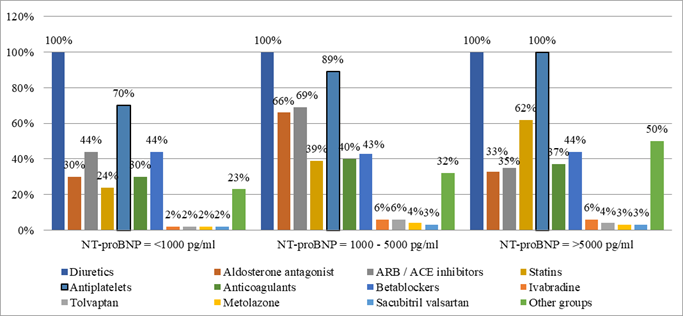
The NT-proBNP distribution showed 49% of patients with levels >1000 pg/ml, with 40% exceeding 5000 pg/ml, indicating significant disease burden. Diuretic use (100%) across all three elevated NT-proBNP groups underscores their fundamental role in managing congestion, consistent with current guidelines. ARB/ACE inhibitors demonstrated a paradoxical trend, with usage peaking at 69% in the moderate high NT-proBNP group (1000-5000 pg/ml) but declining to 35% in patients with severely elevated levels (>5000 pg/ml), The adoption of newer evidence-based therapies remained disappointingly low: Sacubitril-valsartan (2-3%), Ivabradine (2-6%), and Tolvaptan (2-6%).
Discussion
Our study of 367 heart failure patients revealed male predominance (63%) and elderly predilection (64% aged >60 years), consistent with established epidemiological patterns reported by Mosterd et al.[21]. The NT-proBNP distribution showed 49% of patients with levels >1000 pg/ml, with 40% exceeding 5000 pg/ml, indicating significant disease burden. These findings align with the prognostic thresholds established by Januzzi et al., where NT-proBNP >1000 pg/ml correlates with adverse outcomes including increased mortality and hospitalization rates (Table 1).
The high proportion of patients with severely elevated NT-proBNP levels underscores the utility of this biomarker for risk stratification in tertiary care settings, as demonstrated by Doust et al. in their systematic review [22]. These findings emphasize the need for early identification and intensive management of high-risk heart failure patients in our population (Table 1).
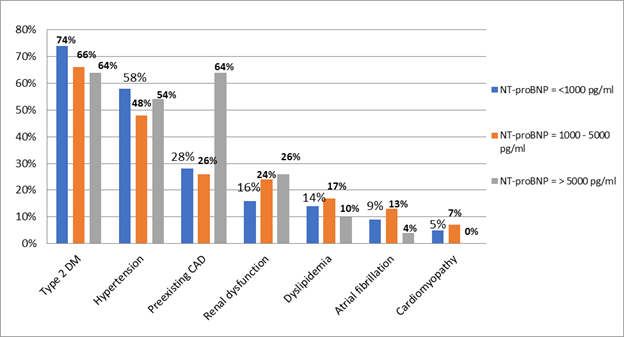
Our analysis revealed a high prevalence of co morbidities among heart failure patients across all raised NT-proBNP categories. Type 2 diabetes mellitus was the most common co morbidity (64-74%), followed by hypertension (48-58%), consistent with previous reports by MacDonald et al. and Dunlay et al., who identified diabetes and hypertension as predominant risk factors in heart failure populations [23,24].Notably, preexisting coronary artery disease showed marked variation across NT-proBNP groups (28% in <1000 pg/ml, 64% in >5000 pg/ml), suggesting a strong association between ischemic etiology and severely elevated NT-proBNP levels, as demonstrated by Braunwald et al.[25] (Figure 3).
Renal dysfunction showed progressive increase with higher NT-proBNP levels (16% to 26%), reflecting the well-established cardio renal syndrome described by Ronco et al.[26]. The substantial co morbidity burden in our cohort emphasizes the importance of comprehensive multimorbidity management in heart failure patients, as these conditions significantly impact prognosis and therapeutic strategies (Figure 3).
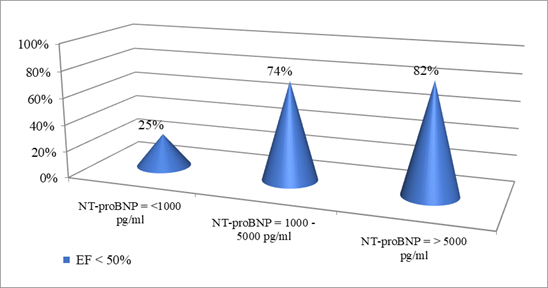
Our study revealed a strong correlation between NT-proBNP levels and reduced ejection fraction (EF <50%) in heart failure patients. Only 25% of patients with NT-proBNP <1000 pg/ml had reduced EF, while this proportion increased dramatically to 74% in the 1000-5000 pg/ml group and 82% in those with NT-proBNP >5000 pg/ml. This progressive relationship aligns with findings by Januzzi et al., who demonstrated that NT-proBNP levels correlate strongly with left ventricular systolic dysfunction and disease severity. The marked increase in reduced EF prevalence with rising NT-proBNP levels underscores the biomarker's utility in identifying patients with HFrEF who require targeted therapeutic interventions including ACE inhibitors, beta-blockers, and mineral corticoid receptor antagonists. Notably, 25% of patients in the lowest NT-proBNP group still exhibited reduced EF, suggesting that while NT-proBNP is valuable, it should be complemented with echocardiographic assessment for comprehensive evaluation, as recommended by Yancy et al. in the ACC/AHA heart failure guidelines [27]. The high prevalence of reduced EF (82%) in the highest NT-proBNP group reflects advanced cardiac dysfunction and corresponds with worse prognosis as reported by Cleland et al., emphasizing the need for aggressive management and consideration for advanced therapies in this population [28] (Figure 1).
Our study revealed significant variations in drug utilization patterns across different NT-proBNP categories, reflecting the complex interplay between disease severity and therapeutic management. Universal diuretic use (100%) across all NT-proBNP groups underscores their fundamental role in managing congestion, consistent with current guidelines. However, the utilization of disease-modifying therapies showed concerning patterns. ARB/ACE inhibitors demonstrated a paradoxical trend, with usage peaking at 69% in the moderate high NT-proBNP group (1000-5000 pg/ml) but declining to 35% in patients with severely elevated levels (>5000 pg/ml), likely attributable to hemodynamic intolerance, renal dysfunction, or hyperkalemia in advanced heart failure. Similarly, aldosterone antagonists showed optimal use in the moderate high group (66%) but decreased substantially in severely high cases (33%), despite evidence from RALES and EMPHASIS-HF trials demonstrating mortality reduction even in advanced heart failure (Figure 2).
Beta-blocker utilization remained consistently suboptimal (43-44%) across all NT-proBNP categories, falling short of guideline recommendations for universal use in heart failure with reduced ejection fraction. This represents a significant treatment gap, as beta-blockers confer substantial mortality and morbidity benefits regardless of disease severity. Antiplatelet therapy showed progressive increase with rising NT-proBNP levels (70% to 100%), reflecting higher prevalence of ischemic etiology in patients with severe biomarker elevation. Statin use demonstrated an interesting pattern, increasing from 24% in the mildly elevated NT-proBNP group to 62% in the severely elevated group, correlating with higher atherosclerotic burden. The adoption of newer evidence-based therapies remained disappointingly low: sacubitril-valsartan (2-3%), ivabradine (2-6%), and tolvaptan (2-6%), despite compelling evidence from PARADIGM-HF, SHIFT, and EVEREST trials respectively, suggesting barriers related to cost, availability, or awareness in our tertiary care setting (Figure 2).
NT-proBNP has emerged as a powerful prognostic biomarker in heart failure management, with levels above 1000 pg/ml independently predicting adverse outcomes including mortality, hospitalization, and disease progression. The concept of NT-proBNP-guided therapy represents a paradigm shift from traditional symptom-based management to biomarker-driven treatment optimization. Jourdain et al. in the STARS-BNP study showed that achieving a 30% reduction in NT-proBNP levels through intensified therapy resulted in significantly lower rates of cardiovascular death and hospitalization compared to clinically-guided treatment [29].
Serial NT-proBNP measurements facilitate identification of patients requiring treatment intensification, enable objective assessment of therapeutic response, and provide targets for medication titration. A meta-analysis by Troughton et al. showed overall benefits of NT-proBNP-guided therapy, particularly when achieving substantial biomarker reductions through systematic up-titration of disease-modifying medications [4].
Importantly, specific drug classes have been demonstrated to significantly reduce NT-proBNP levels, serving as both therapeutic targets and markers of effective treatment. In our study, the utilization of these biomarker-lowering therapies varied across NT-proBNP categories. ACE inhibitors, ARBs, and particularly sacubitril-valsartan have shown substantial NT-proBNP reduction through neurohormonal blockade, with Morrow et al.[30]. Beta-blockers, utilized in 43-44% of our cohort, also reduce NT-proBNP through heart rate control and reverse remodeling. Aldosterone antagonists, optimally used in the moderate high NT-proBNP group (66%) but underutilized in severe cases (33%), have been shown by Pitt et al. to reduce NT-proBNP levels while providing mortality benefits [31]. Diuretics, universally prescribed in our study, provide acute NT-proBNP reduction through decongestion and volume management. The low adoption of sacubitril-valsartan (2-3%) in our population represents a missed opportunity, as this agent demonstrates superior NT-proBNP reduction compared to ACE inhibitors and translates to improved survival and reduced hospitalizations (Figure 2).
The 2021 ESC guidelines by McDonagh et al. recommend NT-proBNP measurement for diagnosis, risk stratification, and monitoring therapeutic response, emphasizing its role in guiding treatment decisions [17]. In our cohort, 89% of patients had NT-proBNP levels exceeding 1000 pg/ml, indicating substantial disease burden and highlighting the critical need for optimal medical therapy.
| Demographic details of Heart failure patients | |
| Gender | Percentage (%) |
| Male | 63% |
| Female | 37% |
| AGE | |
| 20-40 years | 3% |
| 40-60 years | 33% |
| >60 years | 64% |
| Prognostic classification of NT pro BNP level (pg/ml) among the 367 heart failure patients in % | |
| NT-proBNP = <1000 pg/ml | 11% (43) |
| NT-proBNP = 1000 - 5000 pg/ml | 49% (180) |
| NT-proBNP = > 5000 pg/ml | 40% (144) |
Conclusion
These findings underscore substantial treatment gaps and highlight the urgent need for implementing NT-proBNP-guided therapeutic strategies to optimize medication titration, achieve biomarker targets, and delay disease progression in our population. The observed underutilization of guideline-directed therapies, particularly in patients with severely elevated NT-proBNP, represents a missed opportunity for disease modification. Implementing NT-proBNP-guided treatment protocols could facilitate systematic optimization of renin-angiotensin-aldosterone system inhibitors, beta-blockers, and newer therapies like sacubitril-valsartan, potentially delaying disease progression, reducing hospitalizations, and improving survival. Our findings emphasize the urgent need for institutional protocols incorporating NT-proBNP-guided therapy, improved access to evidence-based medications, and educational initiatives to enhance adherence to guideline-directed medical therapy in our population.
Limitation
The study design limits our ability to establish causal relationships between drug utilization patterns and NT-proBNP levels or to assess temporal changes in biomarker response to therapy. Second, the single-center tertiary care hospital setting may introduce selection bias, as our patient population likely represents more advanced disease compared to community settings, potentially limiting generalizability. Future research should address these limitations through prospective longitudinal studies evaluating NT-proBNP-guided treatment protocols with serial biomarker measurements to assess therapeutic response and clinical outcomes
Abbreviations
NT-proBNP: N-terminal pro-B-type natriuretic peptide
SGLT2: Sodium-Glucose Co-Transporter 2 inhibitors
ARNIs: Angiotensin receptor-Neprilysin inhibitors
HFrEF: Heart Failure with reduced ejection fraction
GDMT: Guideline-Directed Medical Therapy
Declaration
Acknowledgements
The department of Pharmacology and all faculty members for their support to come this study
Conflict of Interest
Nil
Funding Statement
Self Funding